Friday, 21 March 2014

Essex Country Club (Holes 9 - 18)


The difficult eighth green features a shallow, crowned left side and a high, unpinnable right side which could be used to deaden approach shots and let then feed left towards the hole.  

The ninth green features two bunkers benched into the green pad and more small, irregular mounds left.  The siting of this green also offers spectacular views of the front nine.
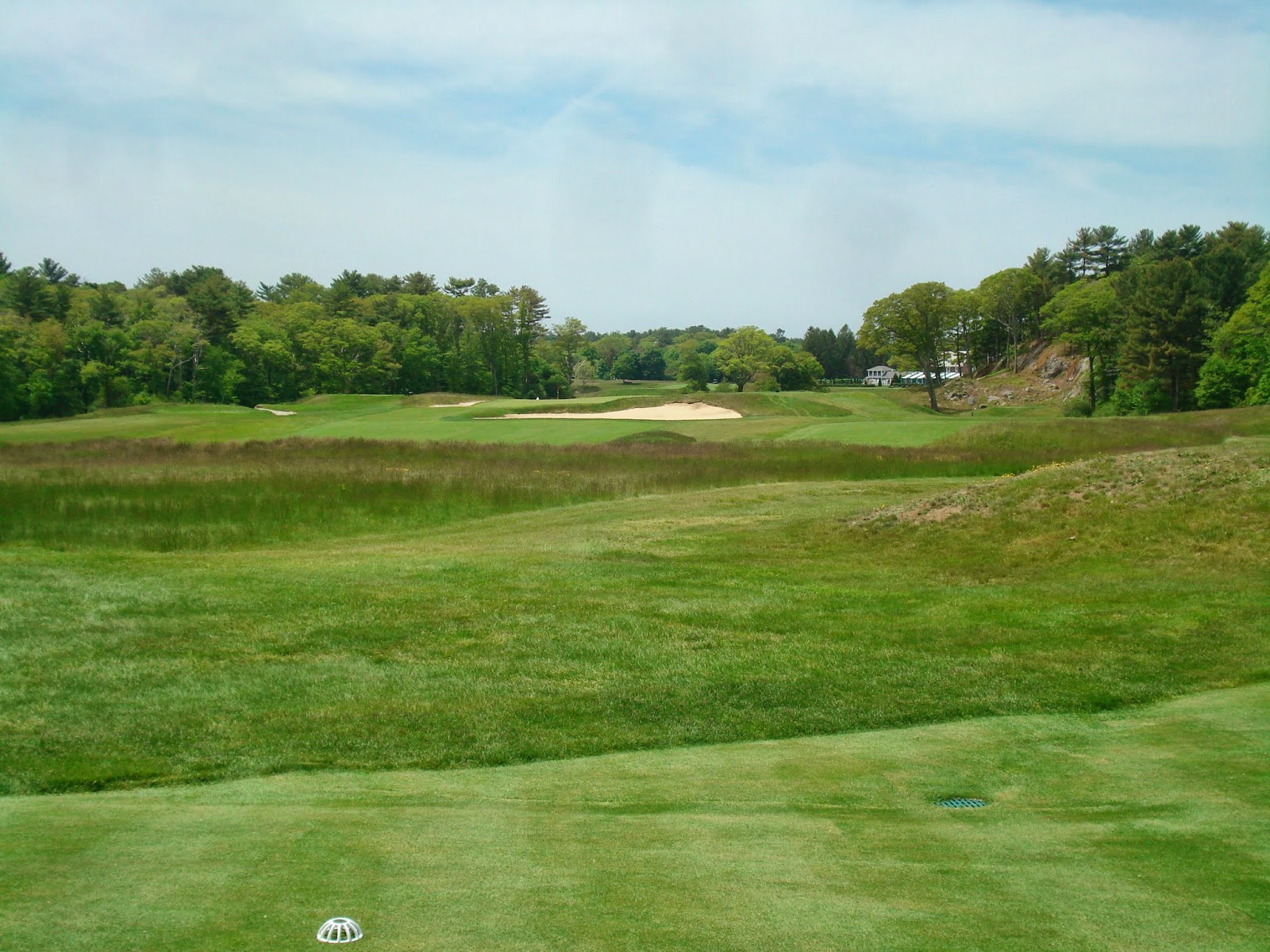
The back nine plays over some heavy undulating terrain.  The centre of the tenth fairway is in line with the tree in the background, but to obtain the best angle of approach drives should flirt with the creek left.

The tenth green is modestly crowned, and the surrounds have been shaved down to allow balls to run into the green side bunkers, as intended by Ross.
The wonderful, uphill par 3 eleventh, featuring menacingly deep hazards left and an excellent back-to-front sloped green.  Recent tree removal behind the green has exposed the terrific landscape at Essex CC.

Trouble awaits any misses at eleven, here seen from behind the green.
The tee shot at twelve plays blind over the right hand shoulder of the hill, which until 2007 was replete with trees.

One of the few downhill approaches at Essex CC, the green features more back-to-front and right-to-left slope than is readily apparent.
The thirteenth features hazards along both sides of the fairway immediately beyond the mounds.  Recovery is possible during dry periods, but the hole is short, so laying back for the sake of accuracy is a smart play.

The green side bunkering nicely incorporates native flora into the faces to give a naturalized appearance.

The thirteenth green is full of movement and interesting putting scenarios.
The par three fourteenth falls away at both sides of the green, and features a subtle swale running perpendicular to the line of play, creating a plateaued back shelf.
A closer look at the contouring of the fourteenth green.

The 16th green surrounds merge nicely into the 15th and 17th tees, creating a unified whole instead of three separate elements.  The fifteenth tee offers a nice preview of the challenges awaiting at seventeen.

The tee shot at fifteen plays diagonally to the fairway over some broken ground featuring fescue grasses and sandy waste.  Again, a large scale bunker has been employed to conceal the elevation from fairway to green.
The fifteenth green slopes heavily from back-to-front and has a lovely backdrop.

A brave drive at sixteen should attempt to carry the bunker set into the hillside on the left, thus avoiding a blind approach into the green.

Approaches played from right of this point in the fairway will be obscured by the fescue-faced waste bunker.  The at grade and subtle green is protected by two deep bunkers left and are barely visible in the photograph.
The short par four seventeenth plays steeply uphill for both the tee and approach shots.

Anticipation of a close approach shot lingers during the steep ascend, but regardless, another excellent green awaits.  Note, the original green was located directly behind the photographer of this picture.

While not personally fond of super elevated tees, the views offered here are worth it.  The drive should be played between the eroded path and bunker on the left hand side hill.

The final approach must negotiate the creek guarding the green closely at front right.  The majestic clubhouse provides a beautiful background.
Essex Country Club is a definite must-see when in the Boston area, and exudes old world charm.  Not overly taxing in terms of distance, but full of mystery and character that would make one never tire of playing this fabulous golf course.

Essex Country Club (Holes 1 - 8)

Essex Country Club in Manchester-by-the-Sea, Massachusetts dates back to 1893, making it one of the oldest clubs in the United States.  The current golf course was re-designed by Donald Ross after the advent of the Haskell ball rendered the original course obsolete.  Ross incorporates two of the original holes (current No. 13 & 16) into his work and left intact the 3rd green, believed to be the oldest in continuous use in the country at 120 years!  The new golf course was built between 1910-1917, but Ross was able to supervise much of the work owing to the fact he had been hired as the golf professional at the club, and served in that position between 1910-1913.  In fact, Ross lived in a house immediately adjacent to the 15th tee (see picture below). 


Essex Country Club is a great example of why pigeon-holing classic architects as having a single style is not prudent.  I have seen pictures of many restorative projects at Donald Ross golf courses, and they bear a striking similarity.  At Essex, Ross employed a variety of bunker styles and made some rather bold design decisions that don't fit with the traditionally held belief of what a Ross course should look like, and would befuddle most architecturally aware golfers trying to assign design attribution to the course.  The routing is however, stereotypically Ross, expertly exploiting the landforms which dominate the property to create a very unique golf course.

The existing golf course is much the same as Ross left it after a final renovation in 1927, which moved the 17th green slightly downhill from its original location.  Sadly however, in 2002 Renaissance Design was hired to re-locate the 14th green approximately 25 yards away from the property line to appease a litigious neighbour.  In comparing with what I saw last year to a photograph in Bradley Klein's wonderful "Discovering Donald Ross" it appears all efforts were made to recreate Ross' original green in this new location.


The opening tee shot plays across a creek to a wide fairway occupying the tamest portion of the property.

The first green has plenty of back-to-front slope and running approaches need to negotiate a grouping of irregular mounds left and bunker right.
The second hole features some turn-of-the-century "chocolate drop" mounding, which are most likely bury piles of rock, which is found in abundance in certain parts of the property.

A dicey approach into the second green awaits, a spine runs through the green diagonally causing balls to release towards the front right bunker and back left edge of the green.
The third is a monster par five measuring 623 yards that demands players reach a plateau on the second shot to avoid a blind approach.  Note the large, flat waste bunkers Ross incorporated into his design which are more commonly seen on modern courses.

The third green is the oldest putting surface in continuous use in the USA, dating back to 1893.  The "bathtub" contour in the front left portion of the green adds great interest to putting.
The long one-shot fourth plays over a pond with large yawning bunkers awaiting misses right.

High shoulders on both sides of the green funnel balls towards the centre of the putting surface, and a steep false front rejects tee shots not played strong enough.
The fifth plays back over the creek into a protuberance of land that encompasses holes 5 through 7. 

A narrow creek protects long approaches into subtle green set at grade.  More fescue covered bury piles exist here adding some contrast to the flat landscape.
Do I go over the creek or lay-up left?  How much further is the carry on the left?  The short sixth ingeniously utilizes the creek as a diagonal hazard creating complexity over flatter terrain.  The large bunker right of the green helps mask the climb on the approach into the elevated green complex.  

The par 3 seventh is guarded by a creek short right and a series of trench bunkers left and right of the green.  The putting surface is split in two by a spine running parallel to the line of play adding another element to an already interesting green.

The eighth tee shot is blind, playing straight over an abrupt rise in the terrain with not a hint as to the proper line to tackle. 
Tee shots hugging the property boundary on the left will gain extra yards owing to nature of the wild fairway undulations.

Saturday, 4 January 2014

Year in Review - 2013

Looking back at 2013, I want to take a brief moment to reflect upon the past year in my golfing adventures.

On the work front, Grant Golf was definitely busier in 2013 from a design standpoint, unfortunately, construction remained stagnant - the notable exception being the construction of a number of new forward tees at Breezy Bend Country Club.  We are looking forward to completing a much larger project for this club in 2014.

Positively, we were hired by the city of Winnipeg to complete a master plan for two municipal courses, Kildonan Park & Windsor Park.  Neither golf course has seen substantial changed over the course of their 90 years and are in need of substantial work to improve turf conditions and overall design strategy.  The major focus of the work will be fairway drainage, tee rebuilding and an overhaul of the bunkering scheme.  Both golf courses are under 5,500 yards in length, and are very busy serving that segment of the golf market.  Our goal is to enhance playability, improve pace of play and make the experience more enjoyable.  We are scheduled to start work in the spring of 2014 and look forward to a long relationship with our new client.

We have also been hired to complete a design for a new golf course in Ghana.  The land at our disposal can only accommodate a 9-hole executive length course and 'Himalayas' putting course, but we hope this will serve as a nice introduction to the sport for many Ghanians and a welcome comfort for the many expatriates working in the region.  Sadly, our contract does not include a trip to Africa, but on a positive note, our new business cards can now advertise our office as "international golf course architects"!!

We are again hopeful that work will begin this upcoming season on a 9-hole expansion of the Lorette Golf Course.  The project is currently in the permitting phase and will be done in conjunction with a residential housing development.

Finally, we received a call just before the new year from a client who is interested in re-starting a currently stalled 18-hole golf course development project.  With any luck, 2014 could be very busy on the construction front.

On the golfing front, my game was decidedly up and down.  My handicap finished at a 2 which is where is began, but there were some painful stretches during the season.  My low game for the year was a 70 at my home club of Glendale G & CC, although the 72 I shot at Tobacco Road in North Carolina on my first look at the course was more impressive.

I made two golf pilgrimages in 2013.  The first being in late May to Boston to visit my good friend Kelly who was then teaching at Harvard School of Design.  During the week of my visit, he gave me a tour of the city, and I gave him a tour of the splendid golf the city has to offer.  We played Old Sandwich Golf Club (Coore & Crenshaw), Plymouth Country Club (Ross), Essex Country Club (Ross) and George Wright Municipal Golf Course (Ross).  I would like to thank Ian Andrew and David Hendler for helping make the trip a success.


Hole No. 2 at Old Sandwich


No. 15 at Plymouth CC
No. 10 at Essex CC
No. 13 at George Wright Municipal

The second trip was to Pinehurst, North Carolina to attend the Dixie Cup, organized by golfclubatlas.com members Craig Disher and Mike Whitaker.  It was a great experience and I met a lot of fantastic people.  During the course of the trip I played Sanford Municipal Golf Course (Ross?), Tobacco Road (Strantz), Dormie Club (Coore & Crenshaw), Mid Pines Inn & Golf Club (Ross) and Pinehurst No. 2 (Ross).  Golfclubatlas.com founder Ran Morrisset hosted us for dinner at his house and I met fellow course architect Richard Mandell.  The north versus south competition ended in an 11-11 tie, but that was truly secondary to the camaraderie enjoyed throughout the matches. 


No. 1 at Tobacco Road
No. 3 at Dormie Club
No. 10 at Mid Pines
No. 7 at Pinehurst No. 2
Thistle Dhu Putting Course at Pinehurst Resort

I did not play much competitive golf this year, but did represent my home club at the annual interclub championship.  While I enjoyed playing the new Tom McBroom designed Southwood Golf & Country Club, I was left awestruck not by the course but by the play of pairing partner Todd Fanning, a former Canadian Tour pro who effortlessly fired a course record 65.

I have always enjoyed writing about golf course architecture and am thoroughly engrossed in its history.  I was happy to get two articles published in 2013, the first was a piece on Winnipeg's classic golf courses that appeared in the May issue of Canadian Golf Magazine.  The second article was published in Volume 6 of Paul Daley's excellent Golf Course Architecture: A Worldwide Perspective series out of Australia and focused on the removal of rough encircling bunkers.  This was the second piece I've had published in this series and hope to continue in the future.  I also contributed to the 17th Revision of the Dr. Alister Mackenzie chronology which was released in March.

Plans for 2014 include a trip to Belgium in May where I plan on playing a number of links courses in the Netherlands and a few courses in Belgium.  My 10 year wedding anniversary is shortly thereafter, so an extended European vacation may be in order.  Perhaps squeeze in one more course near Paris?  Morfontaine certainly intrigues me.  In the fall I am hoping to attend the Dixie Cup again, however, currently the dates and venues aren't set, but regardless, I'll be heading somewhere else during the year for a golf trip.

Monday, 16 December 2013

1/2 Par Holes

I often find the most intriguing and compelling golf holes are those that do not fit neatly into most golfers preconceived notions of par and relative distance.  Hole lengths that lie just outside the traditional spectrum provide enticing options for scratch golfers and hope for higher handicaps to outwit better players.

Good golfers may often refer to a 245-yard par 3 or 285-yard par 4 as par 3 1/2's.  It is striking how focused golfers are on par, to the point that they feel content making 4 on a very long par 3, but walk away disappointed with the same score on a short par 4.  In the former situation, golfers feel compelled to reach the green in one shot (a difficult task owing to the length) because of the par assigned to the hole.  In the latter scenario, the assigned hole par allows them two strokes to cover a relatively short distance, and golfers feel they should be able to make up a stroke on "old man par".  Golf is a mental game, and the value of half-par holes is to accentuate the mental nature of the sport, leading golfers into making poor decisions and often, poorer outcomes.  These negative outcomes tend to stick with golfers for the remainder of their round and can lead some to compound errors by trying to get back what was lost.  

The 14th hole at Dormie Club in West End, North Carolina is a 296-yard par 4.  Ideal placement from the tee must fight the terrain and is more important than length.
An approach from the right side of the fairway must contend with a carry over the green side bunker and...
hold a shallow target.  The orientation of the green to the heavily frequented right side of the fairway is the real genius of the design.  With length not providing an obstacle, higher handicaps can better scratch players who attempt to drive the green and miss right. 
Half-par holes are also important in that they provide the opportunity for bogey golfers to outsmart scratch players.  Holes that are short in distance in relation to par allow higher handicap golfers to reach the green in regulation, giving them the chance to match or better scratch players who pressed for birdie but didn't successfully execute their plan of attack.  On the other end of the spectrum are holes which are long in relation to par.  These holes enable bogey golfers to match or better scratch players through course management.  They may need to sacrifice a stroke to reach the green safely, but that is often good enough against strong competitors who feel compelled to try and reach the green in regulation and fail to meet the difficult test presented to them by the golf course architect.  Again, good golfers are often hesitant to lay-up and attempt low percentage shots because they are focused on the par of the hole rather than completing the course in the fewest number of strokes.

Dormie Club's 14th hole is an effective 1/2 par hole because Coore & Crenshaw provided plenty of width to make driving the green or laying up a real option for long hitters.  This hole isn't a card-wrecker, but will yield plenty of bogies without hitting a truly bad shot. (Photo: Google Earth)   
The 233-yard par 3 at Cypress Point in Pebble Beach, California requires a 205-yard carry over the Pacific Ocean.  Higher handicap golfers are better served by playing a 175-yard shot to the wide fairway short & left of the green, a strategy that may yield lower scores than scratch opponents, especially into the wind.(Photo: Google Earth)  


Thursday, 5 September 2013

Returning Nines

In 1891, Muirfield Links - designed by Old Tom Morris - opened, and its routing represented the first instance of a golf course featuring returning nines.  For centuries, golf courses had been routed in an out and in fashion, with nine holes meandering away from the clubhouse through the linksland before making a distinct turn for home in the second half.  Glance at scorecards from many modern courses and you will be reminded of this feature as totals for the front and back nines are often given the respective monikers, out and in.

Muirfield Links features returning nines, with the front nine running clockwise around the perimeter of the property and the back nine running counter-clockwise within the interior of the property. (Photo: Google Earth)
Most modern golf courses feature returning nines, meaning the first and tenth holes start at the clubhouse.  There are a few benefits to having returning nines.  Early morning weekend tee times are a sought-after commodity, and returning nines allow golf courses to start players off both the 1st and 10th tees, doubling capacity during those premium hours.  Additionally, golfers can opt to play 9 hole rounds when time constraints do not allow for a full eighteen and finally, it is more efficient to keep on-course food & beverage sales near the clubhouse than construct, staff and stock an out-building at a distant point on the property.  While these positives benefit golfers and club owners alike, is it a constraint that may limit the full potential of the architecture.

When golf course architects are given a flat property with limited natural features, the imposition of demanding returning nines is not likely to hinder the overall design, unless the property is awkward in shape or size.  However, when a property abounds with excellent contours and interesting features, returning nines may not yield the very best golf course.  Could masterpieces like Sand Hills or Shinnecock Hills we even better if they did not return to the clubhouse at the ninth green?  If the best golf is what is desired, clients need to be open-minded and consider the possibility of an out and in routing, or a course which returns to the clubhouse after seven, fifteen or any other number of holes other than nine.

Last summer, while competing in the 5th Major at Dismal River Club in Mullen, Nebraska, I has an interesting conversation with the owner Chris Johnston.  While we were playing over the Nicklaus course, Tom Doak was building a second golf course for the club.  Sitting around the fire one night, Chris summoned me over for a Q & A in which he asked me to explain my job as a golf course architect.  I felt that our firm had a responsibility to provide the client with the best possible golf course, and that the existing topography and site features would guide our routing process.  Taking what the land has to offer and not trying to impose certain hole designs onto the land goes a long way toward achieving that goal.  It is rare that clients give architects a complete free-hand, however, they pay the bills, and meeting their demands is also an important component to a successful project.  At the time of our discussion, I'm positive one of the few constraints I would have imposed on myself would be to have the 1st tee and 18th hole return to the clubhouse or some common ground.  Chris explained to me that he wanted the best golf course possible at Dismal River and while that eventual meant ceding some land he didn't see fit for the project, it also meant embracing a design whose 18th green finishes many hundreds of yards away from the opening tee.  While it may not work everywhere, it certainly opened my eyes to exploring different options to provide the best possible golf course.