Friday, 8 May 2015

Year in Review - 2014

The pace of golf design at Grant Golf picked up from the previous year with the most notable project completed being the first phase of a multi-year renovation at Kildonan Park Golf Course.  The municipal golf course has not seen much work over its 90 year history, and much of the work being completed was to breath new life into some distressed golf features.  We re-built five tees and added one additional back tee, and one additional forward tee.  Further, we added four new fairway bunkers that were cut nicely into a ridge the bisects the property.  The existing course did not feature any fairway bunkering, so the opportunity to present a more visually appealing and strategic test is an important element of the overall master plan.  One of the most rewarding days on site was guiding a crew of arborists around the site, removing and pruning trees to let sunlight reach greens and tees.  The instant gratification of such work was a pleasure to experience and will play an vital role in future work at the course.

Bunkers left & right of fairway are staggered and cut into the hillside, adding some challenge and definition to the 13th hole at Kildonan Park Golf Course.
Detail of right hand side fairway bunker.

In the spring we designed an executive golf course & practice facility for the Tano Odumase Recreational Golf & Eco-Tourism Centre in Ghana.  Unfortunately, budget restrictions prevented us from making the trip overseas to see the site first hand or supervise construction.  With golf being very limited in the country, it will be interesting to see how the project turns out and how the construction crews interpret our detailed plans.

Looking forward to 2015, we will begin phase #2 of our master plan for Kildonan Park Golf Course and commence phase #1 at Windsor Park Golf Course.  The emphasis this year will be on fairway drainage at both courses.  Not only will this project improve turf conditions, but will enable both courses to re-open quicker after major rainfall events which will help boost revenue.  The city of Winnipeg continues to be our most active client with further work for this year including the construction of a new practice green at the Crescent Drive Golf Course.

We have a few other clients pondering new work for 2015, and hopefully (after a few years of residential permitting complete) this summer we will break ground on the 9-hole addition at Lorette Golf Course.  

On the golfing front, I played the fewest rounds of golf in 25 years, barely topping 30 in total.  For the first time since I first shot a round of par at age 14, I failed to match or break par in any round during the season, my handicap climbing from 2 to 4.  Thankfully, I seemed to figure my swing issues out at the end of the season, just in time for winter to set in for 6 months!!  I am eager to get out in spring to see if I can figure it all out.

I finally made it to Europe in 2014 and while I had always envisioned by first golf trip across the Atlantic to be in Scotland, England or Ireland, I was not disappointed by the golf I experienced in the Netherlands and Belgium.  As golf was not the primary purpose of the trip, I only snuck in 4 rounds in the Netherlands, enjoying the work of H.S. Colt at Kennemer G & CC, Koninklijke Haagsche G & CC (Royal Hague) and Utretchse GC 'De Pan'.  On the modern side, I played Golfbaan De Swinkelsche where I had the opportunity to discuss the design with the course's architect Frank Pont.  In Belgium, I was fortunate to discover Tom Simpson's Royal GC des Fagnes in Spa and enjoy the course to myself.

The 9th hole at Kennemer G & CC depicts some of the finest links terrain at the club.
The 14th hole at Koninklijke Haagsche G & CC is a thrilling hole on a wonderful links course. 
The heather surrounding the 16th hole at Utretchse De Pan gives the course it's heathland character. 
Wild bunkers & undulating greens are commonplace at Golfbaan De Swinkelsche.  
Strategically located cross-bunkering at No. 12 instill much character into Tom Simpson's parkland Royal Golf des Fagnes.
I did not play much competitive golf this year, but did represent my home club at the annual interclub championship.  It was nice to re-visit Pinawa Golf Club, a track David Grant added 9 holes to back in the 1990's.  The setting of the course is beautiful, and the greens were much better than I'de remembered, full of bold contours and interesting recovery opportunities.  I did manage to finish runner-up in the Glendale G & CC club championship, which happened to be a damp, rain-shortened event.

This past year I was fortunate to pen another article for Paul Daley's wonderful Golf Architecture: A Worldwide Perspective series.  The 7th instalment should be published sometime in 2015 and each volume is a definite must-read for students of golf architecture.  My article focuses on improving pace of play through design.

Plans for 2015 include a trip to Seattle in late April for a wedding and three rounds of golf at Wine Valley GC, Gamble Sands GC, Tumble Creek GC and maybe a Vernon Macan track in Seattle/Tacoma proper.  I would like to play Chambers Bay in Tacoma, site of the 2015 US Open, however, they will be playing to a number of temporary greens leading up to the tournament and that does take away from the experience.  In September, I will be playing in the 2015 Dixie Cup in Tennessee.  During the tournament and extra rounds, I plan to play Holston Hills CC, Cherokee CC, Lookout Mountain GC, Black Creek Club, Sweetens Cove GC and Sewanee University GC.  

Wednesday, 11 June 2014

Pinehurst No. 2

Tomorrow morning, Pinehurst No. 2 will host the United States Open for the third time, however, the 2014 edition of the event will see a significantly altered golf course.  The changes made to the historic Donald Ross design were carried out under the watchful eyes of the architectural team of Bill Coore & Ben Crenshaw.

The wonderful one-shot 9th.
The goal of the work was to restore the strategic design intent and Sandhills appearance of the individual golf holes.  This was accomplished by widening the fairways to create more angles of approach into the greens, and through the removal of 35 acres of irrigated rough, which was replaced with native areas full of sand, wire grass, pine straw and numerous varieties of native grasses.  The current set-up features no rough, with errant drives finding a wide variety of lies - from perfect to pitch-out and everything in between.  Many trees were also felled to open vistas throughout the golf course and give golfers more room to play freely.  In total, the restoration allowed 650 irrigation heads to be removed from the golf course, and the current maintenance program has eliminated over-seeding, keeping the turf grass playing firm and fast throughout the season.  The bunkering has been restored to a 1943 aerial of the golf course courtesy of Craig Disher, with whom I had the pleasure to play a round with at nearby Dormie Club.  Donald Ross tinkered with Pinehurst No. 2 throughout his career, hence the aerial used for the restoration - taken only five years before the great architect died is ideal.  In addition to be restored in terms of size and location, the bunkers were given a more rugged appearance in keeping with the landscape of the area.  Two greens (No. 15 & 17) were modified slightly to provide more hole locations, and while that type of architectural change is not desirable, given the philosophy of the architects involved and the reverence they hold for Pinehurst No. 2, I trust the alterations were kept to the most essential and were minimal in nature.

I was fortunate to play Pinehurst No. 2 last fall (in fact it was the last game I played in 2013) thanks to a friend I'de met only a few days previous who arranged the day before to have us go first off the tee at 6:45 in the morning.  It was a special round, and having caddies to help guide us around was a welcome experience.  For a major championship venue, I found the course eminently playable (I shot 80, albeit the greens speeds were manageable, we played suitable tees for our calibre and the fairways weren't lined with spectators), with the greens and surrounds providing the greatest defence against scratch golfers.  Pinehurst No. 2 is the type of course that good golfers can pile up bogies even on a good day, a test and result that is much more enjoyable than one that yields the potential for round ending holes at every turn.  It is also a course that allows higher handicaps to swing freely, never lose a ball and play around the hazards due to the increased width.  In combination with firm and fast and even a hint of brown turf conditions, a model for faster golf (a remedy the sport is in desperate need of).  I sincerely hope that the public perception of the restored Pinehurst No. 2 will be positive as I feel it is a model for sustainable golf, and is a healthy change to what has been in vogue for the past few decades.

Here at the famed fifth, my caddie told me to play my approach with a 4-iron.  He knew it wasn't enough club, but left me below the front hole location.  A delicate chip (which took its time to settle 3 feet from the hole) followed by a satisfying par putt will always be a cherished memory from the experience.  
The focus of this post will be to highlight some of the positive features of Pinehurst No. 2 rather than be an exhaustive description of the strategic merits of this Donald Ross masterpiece.

Pinehurst No. 2 is routed over a landscape replete with lots of smaller undulations, and by replacing the irrigated rough with native waste areas, Coore & Crenshaw have added lots of contrast to the overall landscape making the golf course much more visually appealing.

No. 3
No. 11
The transition between the fairways, bunkers and native areas are excellent.  The design elements bleed into one another creating a nice harmony between features.

No. 12
No. 1
No. 3
No. 11 (scene of my only birdie, note approach just left of hole)
The restored bunkers have a much more natural appearance, similar to the natural erosion of wind and rain on the Sandhills landscape.

No. 7
No. 17
The green surrounds repel marginal approach shots and place immense pressure on golfer's short games.  The closely mown surrounds allow balls to escape further from the hole, but also provide short game options.  Players with less well-honed skills can play to their strength and if not greedy, get down in three shots.  Professionals and top-ranked amateurs can choose the best option, be it a putt, chip, pitch or flop for recovery shots in an attempt to maintain par figures, but that often comes at the risk of making double-bogey or worse.

My recovery shot from pin high left at No. 2 ended up falling off the front of the green after a less than crisp chip.  The next stroke was a putt for fear of piling up a big number and facing the same shot again.
Over the back of No. 8 green, scene of the famous John Daly "hitting a ball in motion" meltdown.
An over aggressive bunker shot from the front left bunker at No. 10 turned a good birdie opportunity into a bogey six after ending up in this depression.  Note how much smaller the greens actually are, as a good portion of the above funnels balls off its surface.
No. 14
In looking at current aerials of Pinehurst No. 2, there is plenty of width for the rank-and-file amateurs that make up the vast majority of rounds at the course.  However, the fairways begin to narrow further from the tee, maintaining an adequate challenge for the very best players who risk flirting with trouble for a shorter approach shot.

The fairway at No. 12 provides plenty of width to give advantage to players who can play accurately from the tee to gain a better angle of approach.

No. 18 is wide for players not trying to carry the fairway bunker, but narrows considerably and is set at a diagonal to the line of play to confound the highly skilled golfers who elect to take on the challenge.
Pinehurst No. 2 will be in the spotlight for the next four days, and hopefully some of the fundamentals being practiced here will be embraced by the golfing community at large.  From an environmental standpoint, using less water by reducing irrigated turf areas, promoting fast and firm conditions and planting native vegetation will keep Pinehurst No. 2 ahead of the curve.  Further, the wide, playable corridors combined with lack of dense bush and forced carries will help keep rounds faster and more enjoyable, and a happy golfer is a returning golfer.


Friday, 21 March 2014

Essex Country Club (Holes 9 - 18)


The difficult eighth green features a shallow, crowned left side and a high, unpinnable right side which could be used to deaden approach shots and let then feed left towards the hole.  

The ninth green features two bunkers benched into the green pad and more small, irregular mounds left.  The siting of this green also offers spectacular views of the front nine.
The back nine plays over some heavy undulating terrain.  The centre of the tenth fairway is in line with the tree in the background, but to obtain the best angle of approach drives should flirt with the creek left.

The tenth green is modestly crowned, and the surrounds have been shaved down to allow balls to run into the green side bunkers, as intended by Ross.
The wonderful, uphill par 3 eleventh, featuring menacingly deep hazards left and an excellent back-to-front sloped green.  Recent tree removal behind the green has exposed the terrific landscape at Essex CC.

Trouble awaits any misses at eleven, here seen from behind the green.
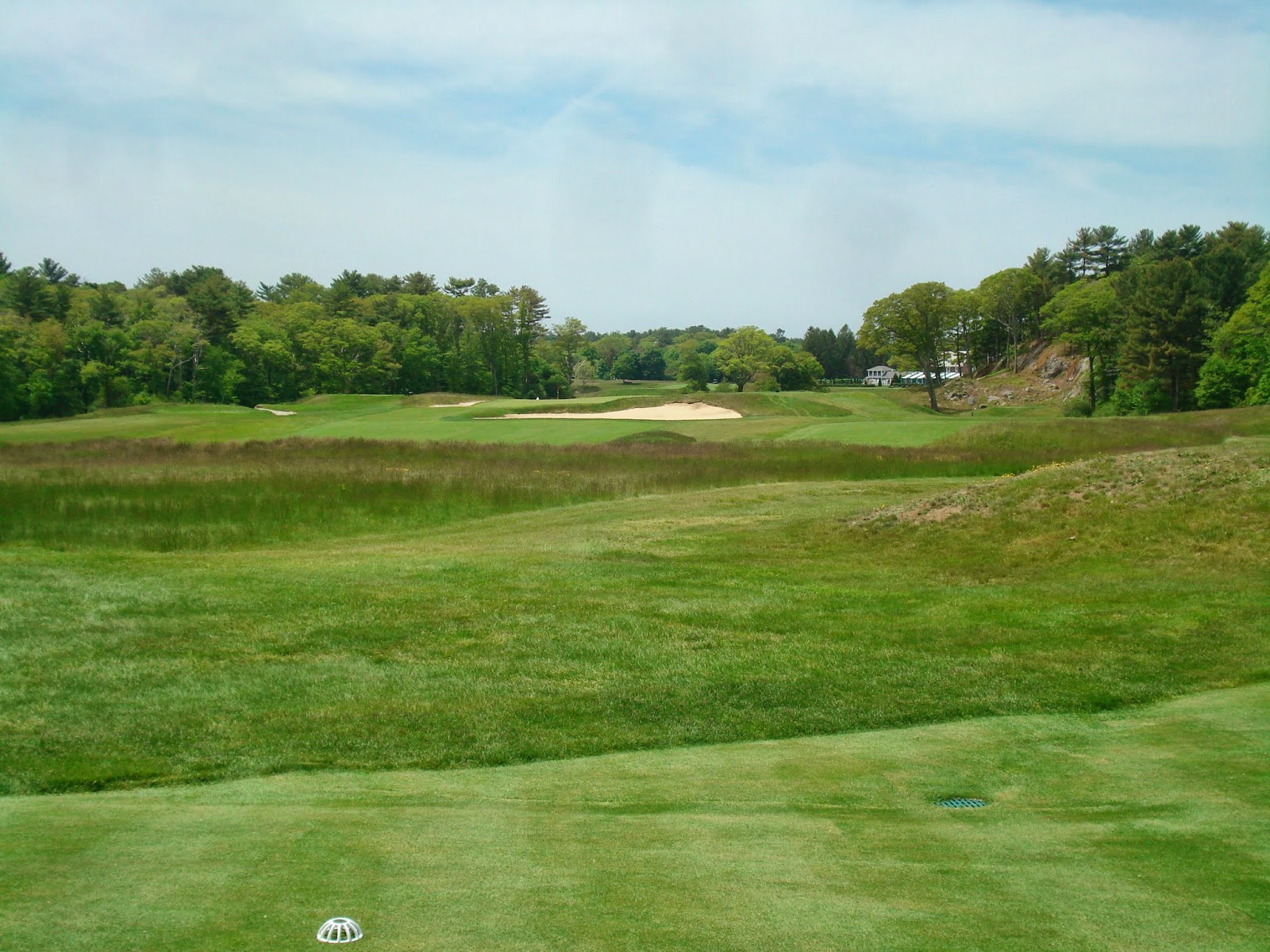
The tee shot at twelve plays blind over the right hand shoulder of the hill, which until 2007 was replete with trees.

One of the few downhill approaches at Essex CC, the green features more back-to-front and right-to-left slope than is readily apparent.
The thirteenth features hazards along both sides of the fairway immediately beyond the mounds.  Recovery is possible during dry periods, but the hole is short, so laying back for the sake of accuracy is a smart play.

The green side bunkering nicely incorporates native flora into the faces to give a naturalized appearance.

The thirteenth green is full of movement and interesting putting scenarios.
The par three fourteenth falls away at both sides of the green, and features a subtle swale running perpendicular to the line of play, creating a plateaued back shelf.
A closer look at the contouring of the fourteenth green.

The 16th green surrounds merge nicely into the 15th and 17th tees, creating a unified whole instead of three separate elements.  The fifteenth tee offers a nice preview of the challenges awaiting at seventeen.

The tee shot at fifteen plays diagonally to the fairway over some broken ground featuring fescue grasses and sandy waste.  Again, a large scale bunker has been employed to conceal the elevation from fairway to green.
The fifteenth green slopes heavily from back-to-front and has a lovely backdrop.

A brave drive at sixteen should attempt to carry the bunker set into the hillside on the left, thus avoiding a blind approach into the green.

Approaches played from right of this point in the fairway will be obscured by the fescue-faced waste bunker.  The at grade and subtle green is protected by two deep bunkers left and are barely visible in the photograph.
The short par four seventeenth plays steeply uphill for both the tee and approach shots.

Anticipation of a close approach shot lingers during the steep ascend, but regardless, another excellent green awaits.  Note, the original green was located directly behind the photographer of this picture.

While not personally fond of super elevated tees, the views offered here are worth it.  The drive should be played between the eroded path and bunker on the left hand side hill.

The final approach must negotiate the creek guarding the green closely at front right.  The majestic clubhouse provides a beautiful background.
Essex Country Club is a definite must-see when in the Boston area, and exudes old world charm.  Not overly taxing in terms of distance, but full of mystery and character that would make one never tire of playing this fabulous golf course.

Essex Country Club (Holes 1 - 8)

Essex Country Club in Manchester-by-the-Sea, Massachusetts dates back to 1893, making it one of the oldest clubs in the United States.  The current golf course was re-designed by Donald Ross after the advent of the Haskell ball rendered the original course obsolete.  Ross incorporates two of the original holes (current No. 13 & 16) into his work and left intact the 3rd green, believed to be the oldest in continuous use in the country at 120 years!  The new golf course was built between 1910-1917, but Ross was able to supervise much of the work owing to the fact he had been hired as the golf professional at the club, and served in that position between 1910-1913.  In fact, Ross lived in a house immediately adjacent to the 15th tee (see picture below). 


Essex Country Club is a great example of why pigeon-holing classic architects as having a single style is not prudent.  I have seen pictures of many restorative projects at Donald Ross golf courses, and they bear a striking similarity.  At Essex, Ross employed a variety of bunker styles and made some rather bold design decisions that don't fit with the traditionally held belief of what a Ross course should look like, and would befuddle most architecturally aware golfers trying to assign design attribution to the course.  The routing is however, stereotypically Ross, expertly exploiting the landforms which dominate the property to create a very unique golf course.

The existing golf course is much the same as Ross left it after a final renovation in 1927, which moved the 17th green slightly downhill from its original location.  Sadly however, in 2002 Renaissance Design was hired to re-locate the 14th green approximately 25 yards away from the property line to appease a litigious neighbour.  In comparing with what I saw last year to a photograph in Bradley Klein's wonderful "Discovering Donald Ross" it appears all efforts were made to recreate Ross' original green in this new location.


The opening tee shot plays across a creek to a wide fairway occupying the tamest portion of the property.

The first green has plenty of back-to-front slope and running approaches need to negotiate a grouping of irregular mounds left and bunker right.
The second hole features some turn-of-the-century "chocolate drop" mounding, which are most likely bury piles of rock, which is found in abundance in certain parts of the property.

A dicey approach into the second green awaits, a spine runs through the green diagonally causing balls to release towards the front right bunker and back left edge of the green.
The third is a monster par five measuring 623 yards that demands players reach a plateau on the second shot to avoid a blind approach.  Note the large, flat waste bunkers Ross incorporated into his design which are more commonly seen on modern courses.

The third green is the oldest putting surface in continuous use in the USA, dating back to 1893.  The "bathtub" contour in the front left portion of the green adds great interest to putting.
The long one-shot fourth plays over a pond with large yawning bunkers awaiting misses right.

High shoulders on both sides of the green funnel balls towards the centre of the putting surface, and a steep false front rejects tee shots not played strong enough.
The fifth plays back over the creek into a protuberance of land that encompasses holes 5 through 7. 

A narrow creek protects long approaches into subtle green set at grade.  More fescue covered bury piles exist here adding some contrast to the flat landscape.
Do I go over the creek or lay-up left?  How much further is the carry on the left?  The short sixth ingeniously utilizes the creek as a diagonal hazard creating complexity over flatter terrain.  The large bunker right of the green helps mask the climb on the approach into the elevated green complex.  

The par 3 seventh is guarded by a creek short right and a series of trench bunkers left and right of the green.  The putting surface is split in two by a spine running parallel to the line of play adding another element to an already interesting green.

The eighth tee shot is blind, playing straight over an abrupt rise in the terrain with not a hint as to the proper line to tackle. 
Tee shots hugging the property boundary on the left will gain extra yards owing to nature of the wild fairway undulations.